- Home Charging
- Charging
- Ownership
BYD Home Charging Guide (2026): Wall Box, Charging Times and Costs
Everything you need to charge your BYD at home: socket vs wall box, charging times for every popular model, the official BYD Smart Wallbox, installation costs and Blade battery charging tips.
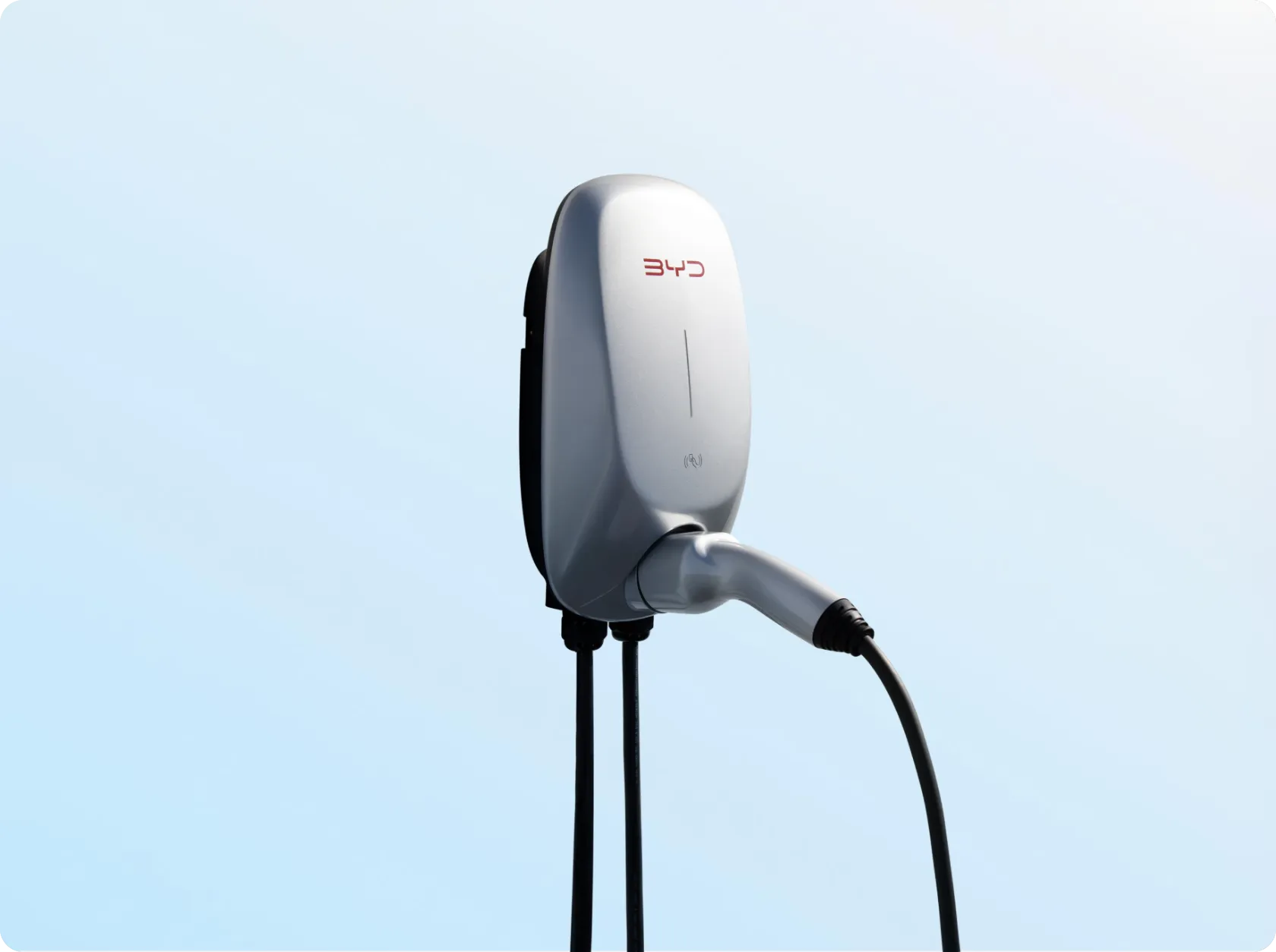
Most electric car owners do the bulk of their charging at home, and for good reason: it is the cheapest, easiest and most battery-friendly way to keep your BYD topped up. You plug in when you get home, the car charges overnight, and you leave every morning with the range you need.
This guide covers everything you need to know about BYD home charging: the options available, how long each BYD model takes to charge, the official BYD Smart Wallbox and its alternatives, installation steps and costs, and how to get the most out of your Blade battery.
Key takeaways
- A 7.4 kW wall box fully charges most BYD electric cars overnight, in roughly 9 to 14 hours from empty.
- The car's onboard charger sets the limit: a 22 kW wall box will not charge faster than the 7 kW or 11 kW your BYD accepts on AC.
- A standard household socket works as a backup, but a full charge can take more than a day.
- In the UK, a 7 kW charger typically costs £700 to £1,200 installed. In Australia, expect around A$1,200 to A$2,300.
- BYD's LFP Blade battery handles full charges well. Charging to 100% at least once a week keeps the range estimate accurate.
How home charging works on a BYD
At home, your BYD charges on alternating current (AC). The electricity from your home is converted to direct current by the onboard charger inside the car, and that onboard charger decides the maximum charging speed. DC rapid chargers, which bypass the onboard charger, are only found on public networks.
In Europe, the UK, Australia, New Zealand and most export markets, BYD electric cars use the Type 2 connector for AC charging, so any certified Type 2 wall box is compatible. Cars sold in China use the local GB/T standard.
Your three BYD home charging options
1. Portable cable on a household socket
BYD supplies or offers a portable charging cable that plugs into a standard outlet. On a typical 10 A socket, it delivers around 2.3 kW, or roughly 10 to 15 km of range per hour. It is fine for occasional top-ups or very low mileage, but it is slow, and older wiring is not always rated for many hours of continuous load. Have an electrician check the circuit before relying on it every day.
2. Single-phase wall box (7.4 kW)
This is the most common setup and the best choice for most homes. A dedicated 7.4 kW wall box on its own protected circuit charges about three times faster than a socket, adding around 35 to 50 km of range per hour, and fully charges most BYD models overnight.
3. Three-phase wall box (11 kW)
If your home has a three-phase supply, which is common in much of continental Europe, an 11 kW wall box can cut charging times by about a third, provided your BYD has an 11 kW onboard charger. Most European versions of the Dolphin, Atto 3, Seal and Sealion 7 do.
| Option | Power | Range added per hour | Best for |
|---|---|---|---|
| Household socket (10 A) | ~2.3 kW | ~10–15 km | Backup, very low mileage |
| Single-phase wall box | 7.4 kW | ~35–50 km | Most homes, overnight charging |
| Three-phase wall box | 11 kW | ~50–70 km | Three-phase homes, high mileage |
How long does it take to charge a BYD at home?
Charging time depends on three things: the size of the battery, the power of your home charger and the maximum AC power of the car's onboard charger. The table below shows approximate times for a full charge from 0 to 100%, including around 10% of charging losses.
| Model (battery) | Socket ~2.3 kW | Wall box 7.4 kW | Wall box 11 kW* |
|---|---|---|---|
| BYD Dolphin (60.48 kWh) | ~29 h | ~9 h | ~6.5 h |
| BYD Atto 3 (60.48 kWh) | ~29 h | ~9 h | ~6.5 h |
| BYD Seal (82.5 kWh) | ~40 h | ~12.5 h | ~8.5 h |
| BYD Sealion 7 (82.5 kWh) | ~40 h | ~12.5 h | ~8.5 h |
| BYD Sealion 7 (91.3 kWh) | ~44 h | ~14 h | ~9 h |
*Only if your car has an 11 kW onboard charger. Versions limited to 7 kW AC charge at the wall box's single-phase speed, even on a more powerful unit.
Real life: you rarely charge from empty
These full-charge times are a worst case. A typical daily drive of 40 km uses roughly 6 to 7 kWh, which a 7.4 kW wall box puts back in under an hour. Most owners simply plug in overnight and never think about charging times at all.
What about BYD DM-i plug-in hybrids?
Plug-in hybrids such as the Seal U DM-i have much smaller batteries, around 18 to 27 kWh depending on the version. A wall box refills them in a few hours, so even a slow overnight charge is enough to start every day on electric power.
The BYD Smart Wallbox
BYD sells its own home charger, the BYD Smart Wallbox, through its dealer network. According to BYD UK, its main features are:
- Charging power from 7.4 kW to 22 kW, depending on the version and your home's supply
- Built-in Wi-Fi and Bluetooth, with control from the BYD app
- Scheduled charging: set a start time and the charger activates automatically during off-peak hours
- Three ways to start a session: Plug & Charge, RFID card or the app
- Charging history, real-time progress and over-the-air updates
- A 5-metre tethered cable, with wall mounting as standard and an optional pole
Choosing the official charger keeps everything in one ecosystem and in one app. Ask your dealer about bundled offers when you buy your car: some include the wall box or its installation.
Can I use a third-party wall box?
Yes. Your BYD does not need a specific brand. Any certified Type 2 wall box will work, including popular models from Wallbox, Ohme, Easee, myenergi (zappi) and many others. When comparing units, look for:
- Smart features: scheduling and app control. In the UK, new home chargers must be smart by law.
- Load management: the charger reduces its power when the rest of the house draws a lot of current, avoiding a costly supply upgrade.
- Solar compatibility: some wall boxes can charge only from your solar surplus.
- Tethered or untethered: a built-in cable is more convenient, a socket-only unit is tidier and more flexible.
How to install a home charger
A wall box must always be installed by a qualified, licensed electrician, following local wiring rules: for example BS 7671 in the UK or AS/NZS 3000 in Australia. The process usually looks like this:
- Site survey: the installer checks your electrical panel, your main fuse and the distance to your parking spot, often from photos.
- Quote: a written price covering the charger, cabling, protection devices and any panel work.
- Installation: usually done in half a day, with the charger on a dedicated circuit protected by a suitable RCD (Type A with 6 mA DC fault detection, or Type B).
- Commissioning: the installer tests the circuit, connects the charger to your Wi-Fi and runs a first charge with your car.
- Paperwork: some countries require you to notify your electricity network operator, and the installer usually handles it.
Living in an apartment or with shared parking? You will usually need approval from the building owner or management before installation. Rules and rights vary from country to country.
How much does BYD home charging cost?
Installation cost
Prices depend on the country, the charger and above all on how complex the installation is. As a reference:
- United Kingdom: a 7 kW charger typically costs £700 to £1,200 fully installed, with most installations around £800 to £1,000 (TotalSkills, 2026). Eligible renters, flat owners and households with on-street parking can get up to £500 off through the government EV chargepoint grant (check current eligibility before booking).
- Australia: most homeowners pay between A$1,200 and A$2,300 for a 7 kW single-phase charger, fully installed (SolarX Energy, based on the Solar Choice price index of March 2026).
The factors that push the price up are the same everywhere: a long cable run between the panel and the parking spot, trenching for outdoor installations, an old switchboard that needs upgrading, and three-phase units. Many countries and regions subsidize home chargers, so check local incentives before you buy.
Cost per charge
Working out what a charge costs is simple: multiply the energy drawn by your electricity price. For example, filling a 60 kWh battery from empty draws about 67 kWh including losses. At 0.25 per kWh in your local currency, that is about 17 for a full charge, for 400 km or more of driving.
With a time-of-use or EV-specific electricity tariff, and charging scheduled overnight, the cost can drop much further. It is one of the main reasons home charging is so much cheaper than public fast charging.
Charging tips for your BYD Blade battery
Every BYD electric car uses the Blade battery, based on lithium iron phosphate (LFP) chemistry. It is very robust and tolerates full charges far better than the nickel-based batteries used by many other brands.
Charge to 100% regularly
Unlike many EVs, a BYD does not need to be capped at 80% every day. On the contrary, a full charge to 100% at least once a week lets the battery management system recalibrate, which keeps the displayed range and battery percentage accurate. Always follow the specific advice in your owner's manual.
Schedule your charging
Use the BYD app or your wall box app to start charging during off-peak hours. You pay less, and you ease the load on the grid.
Precondition while plugged in
In very hot or cold weather, set the cabin temperature from the app while the car is still connected. The energy comes from your home rather than the battery, so you leave with more range.
Keep fast charging for road trips
Slow AC charging at home is the gentlest way to charge any battery. Save DC rapid charging for long journeys, when you actually need the speed.
Frequently asked questions
Can I charge my BYD with a normal household plug?
Yes, using the portable charging cable. It is perfectly safe on a circuit in good condition, but it is slow: a full charge of a 60 kWh battery takes more than a day. For daily use, a wall box is strongly recommended.
Do I need the official BYD Smart Wallbox?
No. Any certified Type 2 wall box is compatible with BYD electric cars in Europe, the UK and Australia. The BYD Smart Wallbox simply offers tighter integration with the BYD app.
Will a 22 kW wall box charge my BYD faster?
Not beyond the car's onboard charger limit. Most BYD models accept 7 kW or 11 kW on AC, so a 22 kW unit only makes sense if you want to future-proof your installation or charge another car that supports it.
Is it OK to leave my BYD plugged in overnight?
Yes. The car stops charging automatically when it reaches the limit you set, and the battery management system protects the battery at all times.
How much range do I get per hour of charging?
Roughly 10 to 15 km per hour on a household socket, 35 to 50 km per hour on a 7.4 kW wall box and 50 to 70 km per hour on an 11 kW wall box, depending on the model and its consumption.
Conclusion
For almost every BYD owner, a 7.4 kW wall box is the ideal home charging setup: a full battery every morning, lower running costs and the gentlest possible charging for your Blade battery. If your home has three-phase power and your BYD accepts 11 kW, a three-phase unit is a worthwhile upgrade.
The best time to plan your home charger is when you buy your car. Your dealer can advise you on the BYD Smart Wallbox, installation partners and current offers. Find a BYD dealer near you, or compare the full range in our BYD model guide.